Extensive freshened water beneath the ocean floor confirmed for the first time
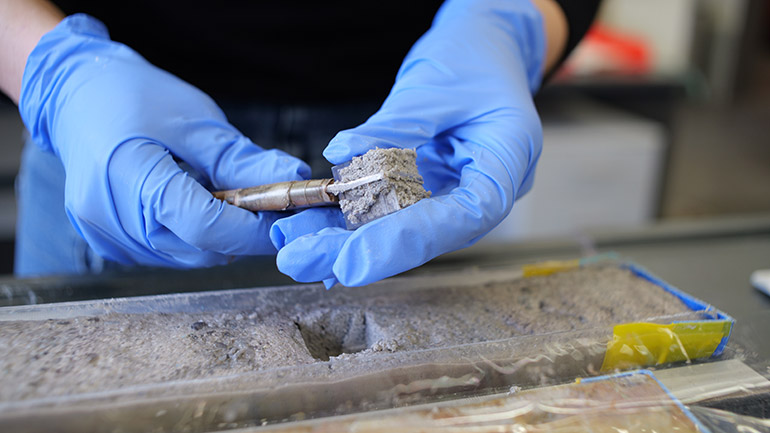
Working on the samples. Credit: Le_Ber@ECORD_IODP³




University of Leicester geoscientists working as part of an international expedition have helped to collect samples of freshened water sealed beneath the ocean floor for potentially thousands of years.
For the first time, a science team directly documented and extensively sampled a freshened water system beneath the ocean floor. This major discovery comes from the initial analyses of sediment cores recovered during an international scientific expedition led by Co-Chief Scientists Professor Brandon Dugan (Colorado School of Mines, Golden, USA) and Professor Rebecca Robinson (Graduate School of Oceanography, University of Rhode Island, USA).
The cores, retrieved from deep below the sea floor, are now being opened, analysed and sampled by the science team, during almost a month of intensive collaborative work at the University of Bremen. During January and February 2026 the expedition’s scientists are working side by side to uncover new insights into the formation, evolution, and significance of this newly documented subseafloor freshwater system.
Members of the IODP3 group at the University of Leicester joined the expedition to provide scientific expertise and support and are also currently taking part in analysis of the samples at the University of Bremen.
The goal of this expedition went far beyond collecting sediment cores. Scientists also set out to sample the water stored within the sediments, including from sandy layers that act as aquifers and from clayey layers that usually keep the water in place beneath the seafloor, known as aquitards. Although roughly 70 per cent of Earth’s surface is covered by water, significant volumes of water also move and are stored below ground. Many coastal communities depend on land-based aquifers for their freshwater supply.
What fewer people realize is that, in many parts of the world these aquifers continue offshore, containing zones of freshened water beneath the ocean floor. Scientists have known these offshore systems existed for decades, but they have remained virtually unexplored until now. During this expedition, the science team has successfully documented and sampled freshened water within a zone nearly 200 metres thick below the seafloor.
Professor Sarah Davies, Professor of Sedimentology and lead of the IODP3 group at the University of Leicester, says: “Expedition 501 has been innovative from the outset, introducing new tools, new methods, and new collaborations across the ocean drilling community. The Onshore Operations continue that momentum, and the cores are already revealing an exciting story.
“For the University of Leicester team, and our partners at Montpellier, this is a particularly rewarding moment— our expertise sits at the heart of some of the expedition’s scientific goals. Once the moratorium ends, this remarkable dataset will be open to the global community, marking the next phase of an exciting research journey.”
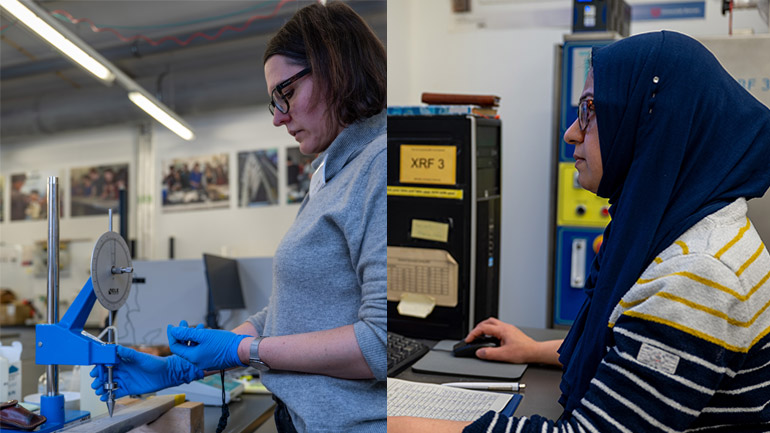
Dr Marisa Rydzy and Dr Tayyaba Khurram from the University of Leicester working at the University of Bremen. Credit: Diekamp@ECORD_IODP3_NSF
Brandon Dugan from Colorado School of Mines, Golden, USA said: “We were excited to see that freshened water exists in multiple kinds of sediments – both marine and terrestrial. Freshened water in such different materials will help us understand the conditions that emplaced the water.” Further analyses that are conducted by the science team will help to find out where and especially when the water was placed here.
Rebecca Robinson from the Graduate School of Oceanography, University of Rhode Island, USA said: “The cores contain sediment with a wide range of composition and ages. It was surprising to see sediment, not rocks, throughout the section. The sediment has not yet transformed into rock – I did not expect to see that and it will be an interesting component of our future work.” In order to understand when and how the sediments were deposited, the science team is developing age models.
The approach used during IODP³-NSF Expedition 501 will not only deepen our understanding of offshore freshened groundwater systems off the coast of New England, but will also shed light on similar hidden water aquifers around the world. Because many coastal regions rely on groundwater for their freshwater supply, the expedition’s initial findings are highly relevant to society. The research will also reveal how nutrients cycle through continental shelf sediments and how these processes influence the abundance and diversity of microbes living in these environments. These goals align closely with the 2050 Science Framework: Exploring Earth by Scientific Ocean Drilling – one of the foundations of the IODP³ scientific programme. Ultimately, the expedition’s research will help to decipher how sediments and fluids cycle through the Earth system and improve our knowledge about sea level changes and freshwater flow beneath the seabed along our coastal shelves.
The expedition is a joint collaboration between the International Ocean Drilling Programme (IODP³) and the US National Science Foundation (NSF). The cores were retrieved during offshore operations between May and August 2025. For onshore operations the science team have met at the Bremen Core Repository, at MARUM – Center for Marine Environmental Sciences of the University of Bremen (Germany). The University of Leicester and its partner Montpellier are part of the ECORD Science Operator, led by the British Geological Survey and working alongside MARUM.
The cores will be archived and made accessible for further scientific research for the scientific community after a one year-moratorium period. All expedition data will be open access in the IODP³ Mission Specific Platform (MSP) data portal in PANGAEA, and resulting outcomes will be published.