New ‘cloaking device’ concept to shield sensitive tech from magnetic fields
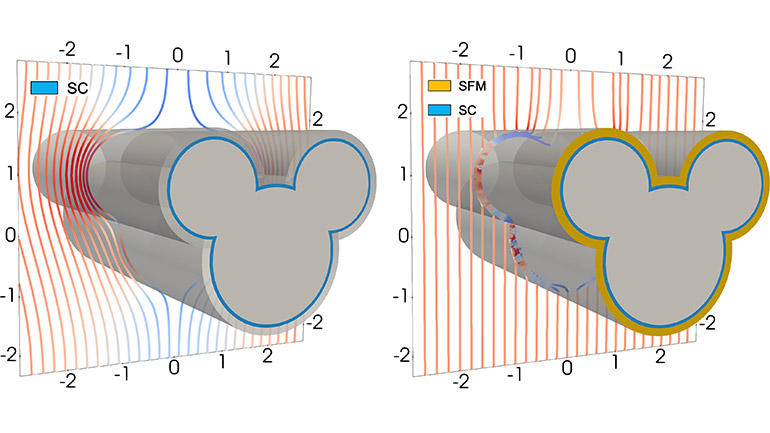
3D and cross-sectional views of an optimized Superconducting (SC)- Soft-Ferromagnetic bilayer (SFM) cloak. At the left no SFM is used showing the diamagnetic response of the SC. At the right the cloaking effect phenomenon is shown.




University of Leicester engineers have unveiled a concept for a device designed to magnetically ‘cloak’ sensitive components, making them invisible to detection.
A magnetic cloak is a device that hides or shields an object from external magnetic fields by manipulating how these flow around an object so that they behave as if the object isn’t there.
In a new study for Science Advances, a team of engineers at the University of Leicester have demonstrated for the first time that practical cloaks can be engineered using superconductors and soft ferromagnets in forms that can be manufactured.
Using computational and theoretical techniques such as advanced mathematical modelling and high-performance simulations based on real-world parameters, they have developed a new physics-informed design framework that allows magnetic cloaks to be created for objects of any shape. Until now, cloaks were mostly theoretical or restricted to simple shapes like cylinders. This study demonstrates for the first time how to design magnetic cloaks for the irregular geometries we see in the real-world. These cloaks also maintain their effectiveness across a broad range of field strengths and frequencies.
Magnetic cloaks could play a vital role in protecting sensitive electronics and sensors from magnetic interference, which is a growing challenge in everything from medical devices to renewable energy and space technology.
Unwanted magnetic fields can disrupt the operation of precision instruments, sensors, and electronic components, leading to signal distortion, data errors, or equipment malfunction. This is a growing concern in environments such as hospitals, power grids, aerospace systems, and scientific laboratories, where increasingly sensitive technologies require effective protection from magnetic interference.
The research opens the door to building magnetic cloaks and magnetic guides tailored to specific devices or components using materials that are already commercially available. Potential applications include shielding of components in fusion reactors, protecting medical imaging systems (like MRI scanners), and isolating quantum sensors in navigation or communication systems.
Dr Harold Ruiz from the University of Leicester School of Engineering said: “Magnetic cloaking is no longer a futuristic concept tied to perfect analytical conditions. This study shows that practical, manufacturable cloaks for complex geometries are within reach, enabling next-generation shielding solutions for science, medicine, and industry.
“Our next step is the fabrication and experimental testing of these magnetic cloaks using high-temperature superconducting tapes and soft magnetic composites. We are already planning follow-up studies and collaborations to bring these designs into real-world settings.”
- Designing Functional Magnetic Cloaks for Real-World Geometries is published in Science Advances, DOI: 10.1126/sciadv.aea2468