People
Dr Rob Parker
Lecturer in Earth Observation and UKRI Future Leaders Fellow
School/Department: Physics and Astronomy, School of
Email: [email protected]
Profile

Tropical wetlands are the largest natural source of methane.
I use satellites, climate models and machine learning to understand how wetlands, forests and fires respond to a changing climate, and what that means for the greenhouse gases in our atmosphere.
I am a Lecturer in Earth Observation in the School of Physics and Astronomy and a UKRI Future Leaders Fellow. My fellowship, TWICE, is building a digital twin of the world's tropical wetlands to monitor their methane emissions and predict how those emissions will change. I lead the Carbon-Climate research team in the Earth Observation Science group at Space Park Leicester, and I am Associate Director (Research) of the Institute for Environmental Futures.
I am part of the National Centre for Earth Observation (NCEO), where I am the institutional lead for Leicester and lead NCEO's digital twin activities. I have worked on satellite measurements of the atmosphere since 2005. I developed the University of Leicester GOSAT methane data record, which research groups around the world use to estimate methane emissions and which is delivered through the ESA Climate Change Initiative, the Copernicus Climate Change Service and EOCIS.
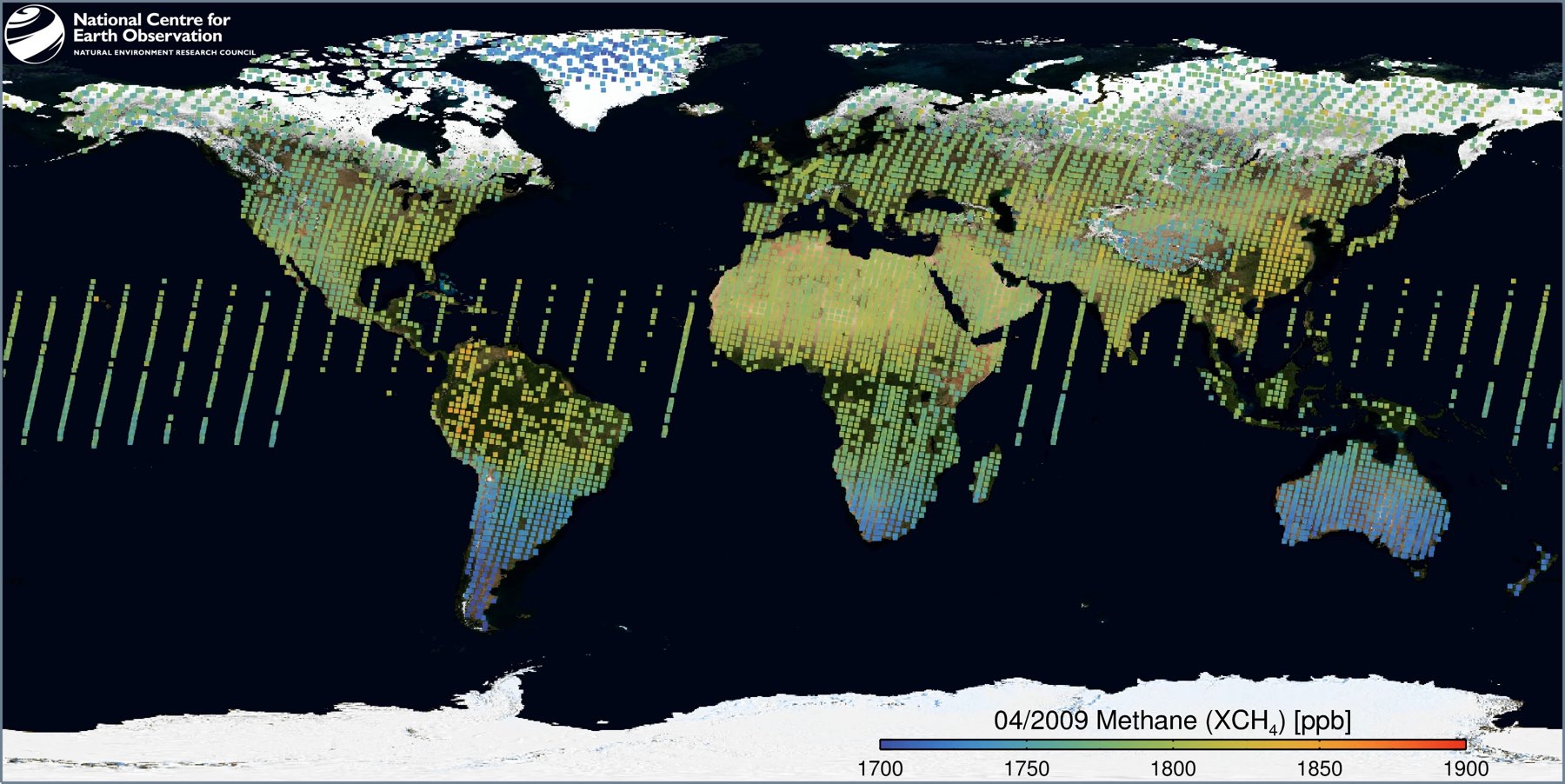
Methane measured by the Japanese GOSAT satellite in April 2009, from the University of Leicester GOSAT data record (NCEO).
I am a member of the UK Earth System Model core group and of the MicroCarb Mission Advisory Group, where I lead UK work on solar-induced fluorescence. I was an ESA Living Planet Fellow from 2015 to 2017.
Opportunities
I welcome enquiries from prospective PhD students and postdoctoral researchers interested in satellite Earth observation, methane, Earth system modelling or machine learning for climate science. Funded PhD projects are advertised on the University's funded opportunities page, including those offered through CENTA.
Research
My research brings satellite observations, land surface and Earth system models, and machine learning together to understand the carbon cycle and how the land responds to climate change.
Tropical wetland methane
- TWICE (UKRI Future Leaders Fellowship, 2024 to 2028). A digital twin of tropical wetland methane emissions that combines satellite methane data, the JULES land surface model and machine-learning emulators.
- CMUG wetland methane (ESA Climate Change Initiative, 2023 to 2027). A machine-learning emulator of JULES wetland methane emissions driven by ESA CCI data.
Satellite greenhouse gas observations
- GOSAT and GOSAT-2 methane. I lead the University of Leicester Proxy XCH4 data records from the Japanese GOSAT and GOSAT-2 satellites, used in the Global Methane Budget and in many regional emission studies.
- MicroCarb (UK Space Agency, 2023 to 2027). UK lead for solar-induced fluorescence on the joint UK-French carbon monitoring mission, launched in 2025.
- GEMMA (NERC, 2023 to 2027). Leicester lead on monthly estimates of UK greenhouse gas emissions in near-real time.
- Sentinel-4 and Sentinel-5 (ESA and EUMETSAT, from 2026). Member of the Cal/Val team.
Earth system model evaluation
- Member of the UK Earth System Model (UKESM) core group since 2015.
- TerraFIRMA (NERC, 2022 to 2027). NCEO lead in this long-term project on future Earth system change and mitigation options.
- CPEO (NCEO International, 2022 to 2027). Work package lead on constraining coupled carbon and water cycle processes with Earth observation.
Digital twins and explainable machine learning
- IKIRERE (STFC Africa-UK Physics Partnership, 2025 to 2027). Drought and heatwaves in East Africa, studied with process models and explainable machine-learning emulators, with partners in Rwanda and Tanzania.
- EXPOSURE (NERC, 2026 to 2028). A prototype urban health digital twin for the UK, combining high-resolution satellite data, urban sensor networks and graph neural networks to show where urban heat and traffic pollution combine.
- PREDICT (ESA, 2024 to 2027). Work package lead on detecting biosphere tipping points and early-warning signals from Earth observation.
- Earlier work includes science lead for the ESA Digital Twin Earth Precursor (2020 to 2021), the NERC digital twin case study on African drought (2021 to 2022) and the ESA IMITATE project on emulating land surface models (2022).
Team
- Michael Cartwright, postdoc, MicroCarb
- Jeremy Emmett, postdoc, TWICE
- Khunsa Fatima, postdoc, TWICE
- Neil Humpage, postdoc, GEMMA
- Zhongwei Liu, postdoc, TerraFIRMA
- Dan Orr, postdoc, MicroCarb
- Cristina Ruiz Villena, postdoc, IKIRERE, PREDICT and CMUG
The team also includes 5 PhD students, listed under Supervision.
Research profiles
Publications
106 publications, cited 8,905 times, h-index 47 (Scopus, September 2026). The full list is on Scopus and ORCID.
Selected publications
- Zhu et al. (2026) Decadal doubling of Siberian methane emissions due to warming-induced fires and methanogenesis. Science. doi:10.1126/science.aea5828
- Parker, R. J., Cartwright, M. P., et al. (2026) A consistent climate data record of atmospheric methane from the GOSAT and GOSAT-2 missions. Earth System Science Data Discussions. doi:10.5194/essd-2026-625
- Saunois et al. (2025) Global Methane Budget 2000–2020. Earth System Science Data, 17, 1873. doi:10.5194/essd-17-1873-2025
- Chen, F., Parker, R. J., et al. (2025) CELNet, a comprehensive efficient learning network for atmospheric plume identification from remotely sensed methane concentration images. Remote Sensing of Environment. doi:10.1016/j.rse.2025.114828
- Qu et al. (2024) Inverse modeling of 2010–2022 satellite observations shows that inundation of the wet tropics drove the 2020–2022 methane surge. PNAS. doi:10.1073/pnas.2402730121
- Feng, L., Palmer, P. I., Parker, R. J., et al. (2023) Methane emissions responsible for record-breaking atmospheric methane growth rates in 2020 and 2021. Atmospheric Chemistry and Physics, 23, 4863. doi:10.5194/acp-23-4863-2023
- Parker, R. J., et al. (2022) Evaluation of wetland CH4 in the JULES land surface model using satellite observations. Biogeosciences, 19, 5779. doi:10.5194/bg-19-5779-2022
- Feng et al. (2022) Tropical methane emissions explain large fraction of recent changes in global atmospheric methane growth rate. Nature Communications. doi:10.1038/s41467-022-28989-z
- Parker, R. J., et al. (2020) A decade of GOSAT Proxy satellite CH4 observations. Earth System Science Data, 12, 3383. doi:10.5194/essd-12-3383-2020
- Parker, R. J., et al. (2020) Exploring constraints on a wetland methane emission ensemble (WetCHARTs) using GOSAT observations. Biogeosciences, 17, 5669. doi:10.5194/bg-17-5669-2020
- Sellar et al. (2019) UKESM1, description and evaluation of the U.K. Earth System Model. Journal of Advances in Modeling Earth Systems, 11, 4513. doi:10.1029/2019MS001739
Supervision
I am first supervisor of 4 PhD students and co-supervisor of 1, and have co-supervised 8 students to completion. My former students have gone on to careers in UK research (including RAL Space and the University of Leicester), at NASA, in finance and in their own environmental company.
Current PhD students
- Shrijana Poudel (from 2022, thesis submitted). Detecting anomalous burned area across the tropics with an explainable isolation forest.
- Chandana Pantula (from 2024). Monitoring tropical wetlands with high-resolution satellite imagery and machine learning, linked to the TWICE fellowship.
- Simone Zheng (from 2025, China Scholarship Council). Understanding wildfire tipping points in the Earth system.
- Charlie Gamblin (from 2026, CENTA with the Met Office). The impact of abrupt permafrost thaw on climate change projections.
- Abdulrahman Alsubaie (from 2024, co-supervised with Heiko Balzter). Modelling carbon and methane cycles in peatlands via multi-source remote sensing data.
Completed PhD students I co-supervised, including
- Dan Orr (2026), Rocio Barrio Guillo (2023), Nikoleta Kalaitzi (2023), Peter Somkuti (2018), Alex Webb (2017), Austin Cogan (2013)
Undergraduate and summer research
I supervise third-year (PA3900) and final-year (PA4900) physics research projects, and host summer research students through the SURE and NERC Research Experience Placement schemes.
Prospective students
If you are interested in a PhD in satellite Earth observation, methane or climate modelling, please email me with your CV and a short note on your interests. Funded projects are listed on the funded opportunities page.
Teaching
- PA1110 Mechanics, Units 3 to 5, for first-year undergraduates (since 2023/24)
- PA1010 Using AI, a session for the whole first-year cohort on using AI tools responsibly (from 2026/27)
- PA3900, supervision of third-year physics research projects
- PA4900, supervision of final-year physics research projects
- PA7201, guest lectures on Earth observation of the atmosphere (MSc)
- CH4023, guest lecture on Earth system science
I am a Fellow of the Higher Education Academy (FHEA).
Press and media
- Leicester experts involved in international project to strengthen climate research and education in Africa (University of Leicester, October 2026)
- Siberian methane emissions have doubled in a decade, study by Leicester scientists finds (University of Leicester, August 2026)
- MicroCarb launches, new carbon monitoring mission showcases NCEO expertise (NCEO, July 2025)
- MicroCarb, carbon monitoring mission using NCEO expertise ready for launch (NCEO, February 2024)
- £1.5m funding to create 'Digital Twin' model to reduce methane emissions (University of Leicester, December 2023)
- Satellite data reveals source of increased global atmospheric methane between 2020-2021 (University of Leicester, April 2023)
Activities
Leadership and committees
- Associate Director (Research), Institute for Environmental Futures, University of Leicester (from 2025)
- Research Impact and Knowledge Exchange lead, School of Physics and Astronomy (from 2025)
- Institutional lead for the University of Leicester, National Centre for Earth Observation (from 2024)
- Lead of digital twin activities, National Centre for Earth Observation (from 2020)
- Leader, Carbon-Climate research team, Earth Observation Science group (from 2023)
National and international groups
- UK Earth System Model core group (from 2015)
- ESA Climate Change Initiative Climate Modelling User Group (from 2022)
- MicroCarb Mission Advisory Group and Science Team, UK lead for solar-induced fluorescence (from 2022)
- ESA and EUMETSAT Sentinel-4 and Sentinel-5 Cal/Val team (from 2026)
- UKRI-NERC Atmospheric Science Forward Look, Public Dialogue Oversight Group (from 2026)
- NERC Digital Research Infrastructure group (2022)
Reviewing and examining
- PhD examiner, including external examining at Imperial College London (2026) and the University of Leeds (2024)
- NERC grant reviewer and funding panel member (2022)
Public engagement
- Royal Society Summer Science Exhibition, Bluedot festival and New Scientist Live
- Events at COP26 (Glasgow, 2021) and COP27 (2022), and a virtual observer at COP29 (2024)
- IKIRERE Physics Camp for secondary school students in Rwanda (2026)
- STEM Ambassador, and organiser of the Earth Observation Science work experience programme
Awards
- UKRI Future Leaders Fellowship (awarded 2023, held 2024 to 2028), TWICE, a digital twin of tropical wetland methane emissions
- ESA Climate Change Initiative Living Planet Fellowship (2015 to 2017), ELEGANCE, exploring the global carbon cycle through atmospheric greenhouse gas variability
- Fellow of the Higher Education Academy (2026)
Qualifications
- PhD, Earth Observation Science, University of Leicester (2009). Satellite observations of C2H2 and C2H6 in the upper troposphere.
- MPhys Physics with Space Science and Technology, University of Leicester (2005)
- Fellow of the Higher Education Academy (2026)